

Find us: Gujarat • Mumbai • Hyderabad • Vizag • Chennai
Advanced Expertise Technology Pvt. Ltd (ADVETPL) manufactures pharmaceutical process equipment and provides fluoropolymer coating and lining solutions in Gujarat, India, with engineering experience since 2004.
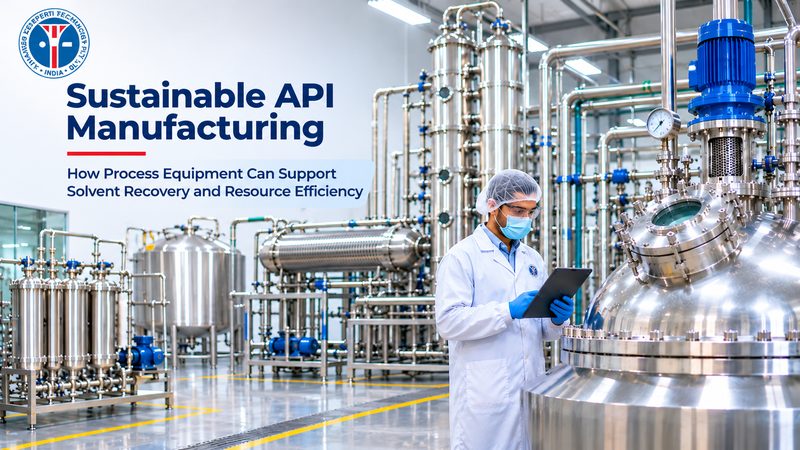
In pharmaceutical manufacturing, solvents do much more than dissolve chemicals. They support reactions, extraction, crystallisation, washing, and purification throughout active pharmaceutical ingredient (API) production. However, once these processes are complete, significant quantities of solvents may remain in spent process streams, creating additional disposal costs and environmental challenges.
For manufacturers looking to improve resource efficiency, solvent recovery is becoming an important part of the conversation. The opportunity is not simply to reduce waste, but to rethink how process equipment can support more responsible material utilisation without compromising product quality or manufacturing consistency.
Solvents can represent a substantial share of the material used and waste generated during API production. Depending on the manufacturing process, a solvent may be used across several stages before being discarded or sent for treatment.
Recovering suitable solvents can reduce the need for fresh solvent purchases, lower waste-treatment requirements, and improve overall material efficiency.
However, recovery is not automatically beneficial in every application. Solvent mixtures may contain impurities, reaction residues, water, or other chemicals that make separation difficult. Manufacturers must evaluate whether the recovered material can meet the quality requirements of its intended reuse.
This makes process assessment just as important as the recovery technology itself.
Equipment selection and configuration influence how effectively manufacturers can handle, separate, and reuse solvents.
Several equipment considerations deserve attention:
Reactors are central to many API manufacturing operations. Their operating temperature, pressure conditions, agitation arrangements, and material compatibility influence process performance.
Appropriate vessel design and reliable connections also help minimise leakage and material losses during solvent charging, processing, and transfer.
Filtration equipment can help separate solids from liquid process streams before further solvent treatment or recovery.
The choice of filtration arrangement depends on particle characteristics, solvent properties, operating pressure, cleaning requirements, and the quality needed in the downstream process.
Drying systems help remove residual moisture or solvents from processed materials. Vacuum performance, heat transfer, temperature control, and product handling are important considerations when selecting suitable equipment.
The equipment must support the required drying conditions without adversely affecting product quality.
Solvent handling requires careful attention to process conditions.
Temperature influences solvent vapour pressure, evaporation behaviour, and separation performance. Pressure conditions affect equipment selection, containment, and safe operation. These parameters must be evaluated together rather than independently.
Material compatibility is equally important. Contact surfaces, seals, gaskets, pipelines, and fittings should be suitable for the solvents and process conditions involved.
For demanding chemical environments, appropriate corrosion-resistant materials or specialised fluoropolymer coatings and linings may help protect selected equipment surfaces. The correct solution depends on solvent chemistry, temperature, mechanical conditions, and the specific equipment application.
Resource efficiency begins before a solvent reaches a recovery system.
Manufacturers can review solvent charging practices, transfer arrangements, storage, process-stream segregation, and equipment connections to identify avoidable losses.
Separating compatible solvent streams can also simplify subsequent recovery operations. Mixing different waste streams unnecessarily may make purification more complicated and increase processing requirements.
Recovered solvents must be tested against predefined quality specifications before being approved for reuse in pharmaceutical manufacturing.
At ADVETPL, the focus is on engineering process equipment solutions for pharmaceutical and chemical manufacturing applications.
Reactors, filtration systems, drying equipment, and specialised surface-protection solutions all have a role in supporting reliable process operations. Their design, material selection, and operating suitability should be considered as part of the wider manufacturing system.
Sustainable API manufacturing is not achieved through a single recovery machine or an isolated environmental initiative. It requires a coordinated approach to process design, equipment selection, material compatibility, and resource management.
By examining how solvents move through manufacturing operations and where avoidable losses occur, manufacturers can identify practical opportunities to improve efficiency.
The real value lies in designing processes that make better use of materials while maintaining the reliability and quality expected from pharmaceutical production.