

Find us: Gujarat • Mumbai • Hyderabad • Vizag • Chennai
Advanced Expertise Technology Pvt. Ltd (ADVETPL) manufactures pharmaceutical process equipment and provides fluoropolymer coating and lining solutions in Gujarat, India, with engineering experience since 2004.
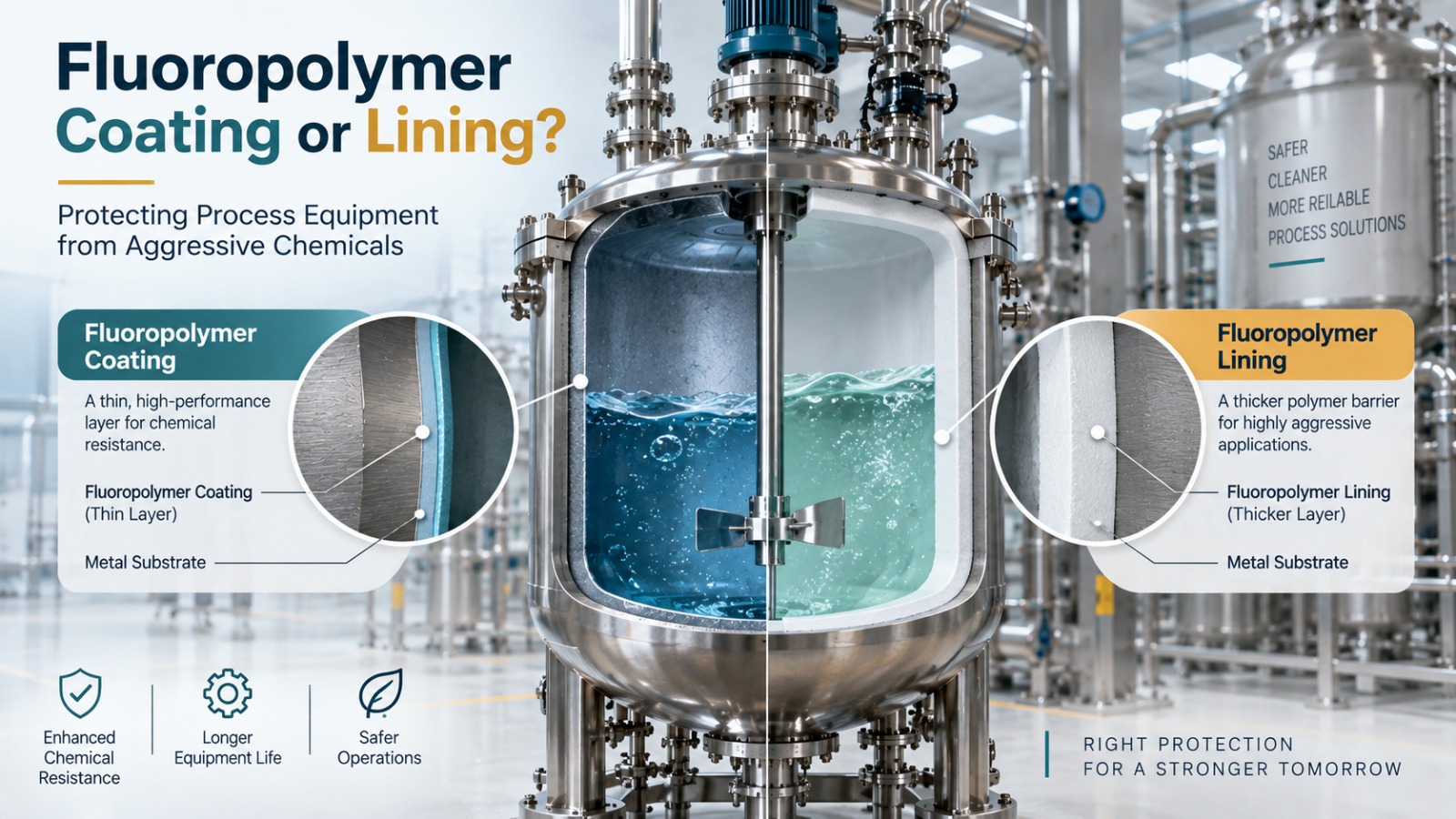
Pharmaceutical and chemical process equipment often operates in contact with aggressive acids, alkalis, solvents, oxidizing agents, and other corrosive chemicals. Even when equipment is manufactured from stainless steel or other corrosion-resistant metals, the process environment may eventually demand additional protection.
This raises an important engineering question: Is a fluoropolymer coating better than a lining for protecting process equipment?
There is no universal answer. The better choice depends on chemical exposure, operating temperature, equipment geometry, mechanical conditions, and the level of barrier protection required.
A fluoropolymer coating is a protective layer applied directly to the equipment surface. It can provide chemical resistance, non-stick properties, and surface protection while retaining the underlying metal as the primary structural material.
A fluoropolymer lining creates a more substantial barrier between the process media and the equipment substrate. Depending on the application, lining may involve sheet lining or rotational lining using materials such as PTFE, PFA, ETFE, or PVDF.
The difference is therefore not simply the material being used. It is also the thickness, construction, application method, and role of the protective layer.
Coating can be advantageous when equipment requires chemical protection without adding a relatively thick liner.
For example, PTFE coating for equipment and vessels can provide a chemically resistant, low-friction surface. PTFE coating on MS equipment or PTFE coating on SS equipment can be considered when the underlying metal provides the required structural strength but its surface needs additional protection.
Coatings can also be attractive for equipment with complex shapes or surfaces where applying a fabricated liner would be difficult.
Another consideration is heat transfer. Because fluoropolymer coatings can be applied as relatively thin protective layers, they may be better suited to certain heat-transfer components where minimizing additional thermal resistance is important. Fluoropolymer coatings are used on metal heaters and heat exchangers for aggressive chemical service, although coating thickness and process design must be carefully controlled.
Lining becomes more attractive when the equipment requires a substantial chemical barrier against aggressive and continuous process exposure.
A properly engineered liner can provide greater material thickness between the chemical environment and the structural substrate. This can be particularly important when chemical permeation, long-term exposure, or severe corrosion protection requirements are major concerns.
Depending on equipment design, ETFE sheet lining, PFA sheet lining, and PVDF sheet lining can be considered. Rotational processes may also be appropriate for applications involving ETFE roto lining, PFA roto lining, or PVDF roto lining.
For demanding applications, the lining material must be selected according to the actual chemical, thermal, pressure, and mechanical conditions rather than simply choosing the thickest available liner.
The answer becomes clearer when the operating priorities are compared.
Coating may be better when:
Lining may be better when:
Neither approach should automatically be considered superior.
Yes. The coating-versus-lining decision is only the first step.
PTFE is widely valued for broad chemical resistance and low-friction characteristics. PFA combines strong chemical resistance with melt-processability and can be used in demanding lining applications. ETFE offers a useful combination of chemical resistance and mechanical toughness. PVDF provides chemical resistance together with useful mechanical and fabrication characteristics.
The material should be evaluated against the actual process chemistry, concentration, temperature, pressure, mechanical stresses, and equipment design. Fluoropolymers are not interchangeable simply because they belong to the same family.
Before selecting an anti corrosion coating for chemical equipment or a fluoropolymer lining, engineers should evaluate:
Surface preparation and application quality are equally important. Even a chemically compatible fluoropolymer can underperform if the substrate preparation, adhesion, thickness, fabrication, or inspection is inadequate.
The better question is not “Which is universally better?”
It is: “Which protection system provides the required chemical resistance while matching the equipment and operating conditions?”
For some applications, a fluoropolymer coating can provide the right balance of protection, thickness, geometry, and heat-transfer performance. For others, a fluoropolymer lining provides the more appropriate barrier against aggressive chemical exposure.
The decision should therefore be based on engineering evaluation rather than material preference alone.
The takeaway: The right protection system is the one engineered for your equipment and process — not the thickest or most chemically resistant option. Talk to ADVETPL’s experts →
Tell us where to send it — the full ADVETPL equipment & coatings catalogue (PDF) starts right away.