

Find us: Gujarat • Mumbai • Hyderabad • Vizag • Chennai
Advanced Expertise Technology Pvt. Ltd (ADVETPL) manufactures pharmaceutical process equipment and provides fluoropolymer coating and lining solutions in Gujarat, India, with engineering experience since 2004.
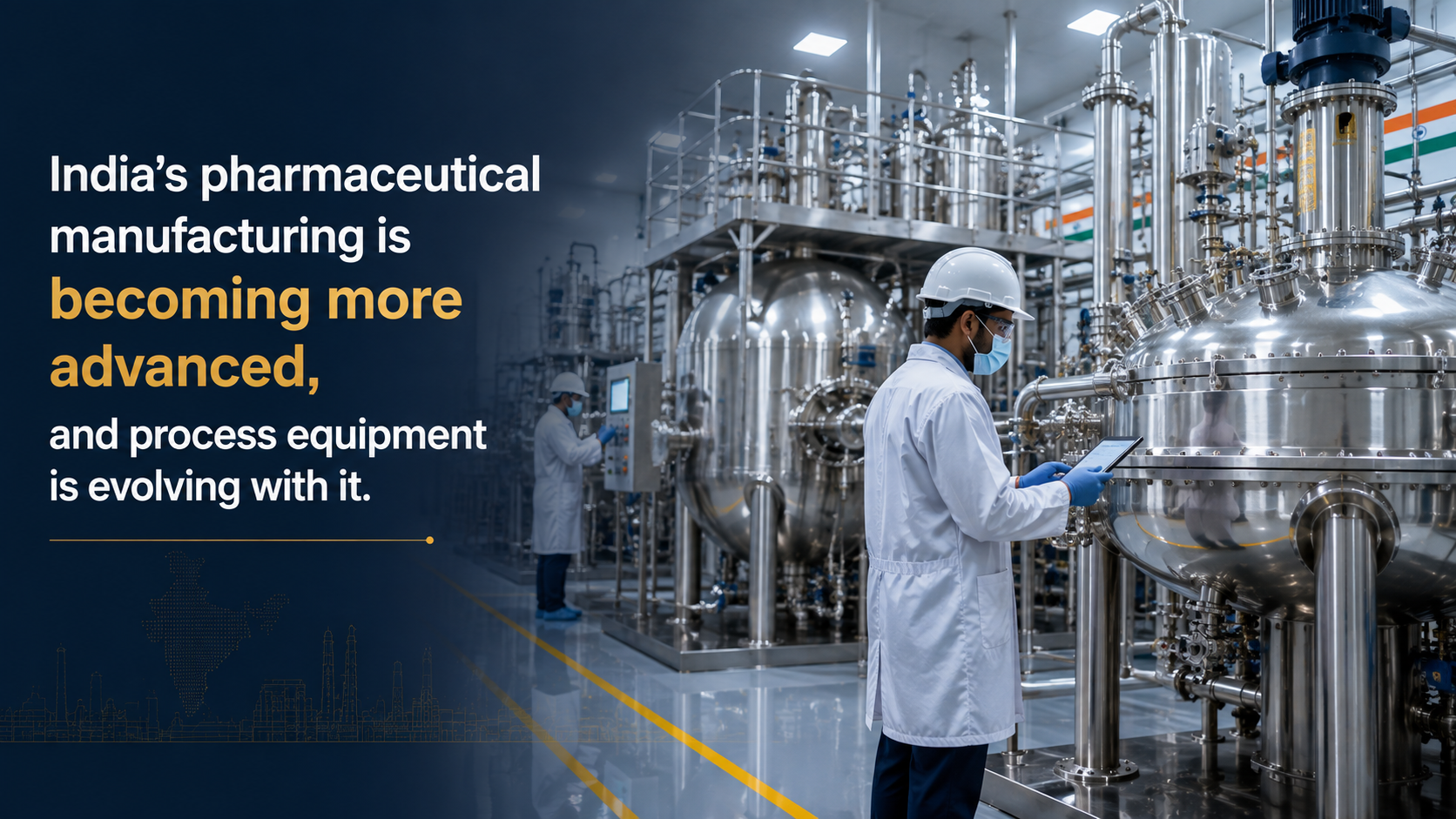
India’s pharmaceutical manufacturing industry is expanding, but increasing capacity is only one part of the equation. As manufacturers invest in APIs, complex generics and higher-value pharmaceutical products, the demands placed on production systems are also changing.
For plant heads, engineering teams and procurement professionals, this raises an important question: what should pharmaceutical process equipment deliver as manufacturing requirements become more complex?
The answer goes beyond capacity. Equipment must be compatible with the process, reliable under demanding conditions, efficient to operate and capable of supporting long-term production requirements.
India’s push toward greater domestic manufacturing of APIs, KSMs and drug intermediates is encouraging investment in new production infrastructure. At the same time, pharmaceutical manufacturers are expanding into higher-value and more technically complex products.
These developments can introduce more demanding operating conditions, including chemical exposure, solvent handling, temperature and pressure requirements, tighter process controls and greater expectations for consistency.
For equipment buyers, this means that selecting machinery based only on throughput or initial cost can overlook factors that have a much greater impact over the equipment’s operating life.
The first question should always be whether the equipment is appropriate for the actual process.
Pharmaceutical and API manufacturing can involve solvents, acids, alkalis and other aggressive process media. Equipment must be capable of handling these conditions while maintaining performance and protecting the integrity of the process.
Reactors, pressure vessels, filters and other process equipment should therefore be evaluated against actual operating parameters rather than generic specifications.
Filtration and separation influence product recovery, purity and process consistency.
Depending on the application, manufacturers may require technologies such as Agitated Nutsche Filter Dryers, Pressure Nutsche Filters, Sparkler Filters, Candle or Basket Filters and centrifuges.
The key consideration is how effectively the equipment fits into the complete manufacturing process. Factors such as product characteristics, solids loading, filtration requirements and downstream processing can all influence equipment selection.
Drying is another stage where equipment selection can influence both productivity and product quality.
Manufacturers need to consider drying time, temperature sensitivity, solvent handling, moisture requirements and energy consumption. Equipment such as Fluid Bed Dryers, Vacuum Tray Dryers, Rotary Vacuum Paddle Dryers and Rotocone Vacuum Dryers can serve different process needs.
The objective should be consistent drying performance without compromising product characteristics or operational efficiency.
As processes become more demanding, material compatibility becomes increasingly important.
Certain applications may expose equipment to corrosive chemicals or solvents where additional protection is required. Fluoropolymer coating and lining can be considered as part of an equipment protection strategy.
PTFE, PFA, ETFE, PVDF and Halar® offer different characteristics and should be selected according to the application. Chemical exposure, temperature, mechanical requirements, substrate and process conditions all need to be evaluated.
The important point is that coating selection should be application-specific rather than based on a one-size-fits-all approach.
Equipment selection should not end when the machinery is installed.
Regular inspection, preventive maintenance, repair, recoating, relining and refurbishment can all play a role in maintaining equipment performance and extending asset life.
For manufacturers, this can make lifecycle capability an important factor when choosing a pharmaceutical equipment manufacturer. A supplier with expertise across equipment manufacturing and specialized surface protection can potentially provide more comprehensive support as production requirements evolve.
Not necessarily.
As pharmaceutical companies expand production, there may be situations where existing equipment can continue to perform effectively with appropriate maintenance, repair, refurbishment or recoating.
The decision should consider equipment condition, process requirements, remaining service life, operating environment, downtime implications and total cost.
This lifecycle approach can help manufacturers make more informed decisions about whether to replace, refurbish, reline or recoat an asset.
A capable supplier should offer more than a catalogue of pharmaceutical machinery.
Manufacturers should consider whether the supplier understands process requirements, material compatibility, fabrication, surface protection and lifecycle support. Custom engineering capability can also be important when standard equipment does not fully address a particular application.
Total cost of ownership should remain central to the decision. Equipment that performs reliably, can be maintained effectively and has viable lifecycle support may deliver greater value than equipment selected primarily for a lower upfront price.
India’s pharmaceutical manufacturing growth is creating a more sophisticated equipment environment.
As domestic API capacity expands and manufacturers pursue increasingly complex production capabilities, pharmaceutical process equipment will need to deliver greater reliability, compatibility, efficiency and long-term performance.
The takeaway: The objective should not simply be to acquire more machinery. It should be to select equipment engineered for the process, protected for the environment and supported throughout its lifecycle — ready not only for today’s requirements, but for the next stage of India’s pharmaceutical manufacturing growth.