

Find us: Gujarat • Mumbai • Hyderabad • Vizag • Chennai
Advanced Expertise Technology Pvt. Ltd (ADVETPL) manufactures pharmaceutical process equipment and provides fluoropolymer coating and lining solutions in Gujarat, India, with engineering experience since 2004.
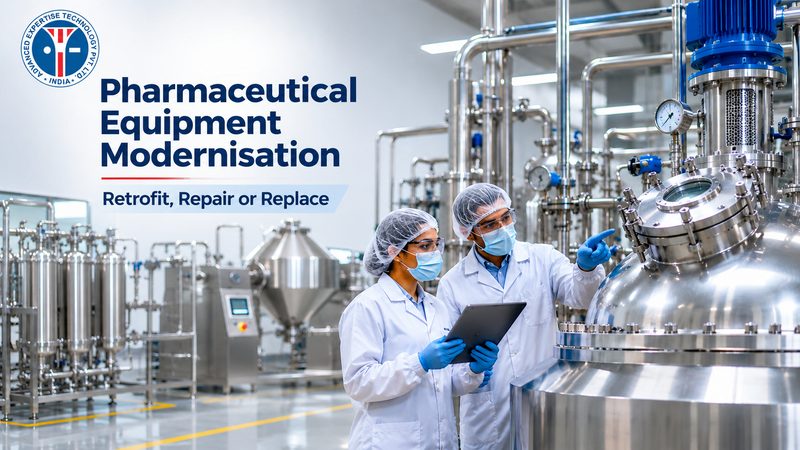
Pharmaceutical manufacturing equipment is expected to deliver consistent performance, maintain product quality, and operate reliably under demanding production conditions. But as equipment ages, manufacturers eventually face an important question: should they repair the existing machine, invest in a retrofit, or replace it altogether?
With rising operating costs, pricing pressures, and increasing expectations around manufacturing quality, making the right equipment investment decision has become more important than ever. The answer is not always to purchase new machinery. Sometimes, a carefully planned repair or modernisation project can deliver the improvement a facility needs.
Over time, even well-maintained pharmaceutical equipment can experience wear, reduced efficiency, outdated controls, and increasing maintenance requirements. These issues may affect production schedules, energy consumption, product consistency, and overall operating costs.
For manufacturers, the challenge is to maintain dependable production without committing capital unnecessarily. Equipment modernisation provides an opportunity to address existing limitations while making better use of available infrastructure.
However, modernisation should begin with an assessment of equipment condition and process requirements, rather than age alone.
Each option serves a different purpose.
Repair is generally appropriate when equipment remains structurally sound and the problem is limited to a specific component or mechanical issue.
Replacing worn parts, correcting leaks, restoring damaged connections, or addressing minor mechanical faults may bring equipment back to reliable operation without requiring a major investment.
A retrofit is worth considering when the basic equipment remains suitable for its application but certain features need improvement.
This could involve upgrading selected components, improving controls, replacing outdated instrumentation, or modifying equipment to accommodate changing process requirements.
The objective is to improve functionality while retaining useful existing assets.
Replacement may be the better decision when equipment has extensive structural deterioration, recurring failures, unsuitable design characteristics, or limitations that cannot be addressed economically.
If an existing machine repeatedly disrupts production or cannot meet current process requirements, investing in another repair may only postpone a larger problem.
Modernisation decisions are particularly important for critical process equipment.
A machine should always be assessed according to its intended application and operating conditions.
The purchase price is only one part of the equipment investment.
Manufacturers should also consider maintenance expenditure, spare-part availability, energy consumption, production interruptions, cleaning requirements, and expected remaining service life.
A lower-cost repair may become expensive if the same fault repeatedly returns. Similarly, a new machine may involve substantial installation, qualification, and production-disruption costs.
The more useful question is: which option offers the most reliable performance and value over the equipment’s remaining lifecycle?
Any modification to GMP-relevant equipment should also undergo appropriate technical assessment, change control, and qualification or requalification where required.
Successful modernisation requires more than replacing components. It requires an understanding of the process, equipment design, material selection, fabrication quality, and long-term operating requirements.
At ADVETPL, the focus is on supporting pharmaceutical and chemical manufacturers through process-equipment engineering solutions, refurbishment considerations, and lifecycle support.
Whether the requirement involves reactors, filtration systems, drying equipment, or specialised equipment surfaces, the right approach begins with understanding the application.
Pharmaceutical equipment modernisation is not simply about buying new machinery. It is about knowing when existing equipment can be improved, when repairs are sufficient, and when replacement offers better long-term value.
A structured assessment can help manufacturers control costs, improve equipment reliability, and make informed investment decisions without compromising process requirements.