

Find us: Gujarat • Mumbai • Hyderabad • Vizag • Chennai
Advanced Expertise Technology Pvt. Ltd (ADVETPL) manufactures pharmaceutical process equipment and provides fluoropolymer coating and lining solutions in Gujarat, India, with engineering experience since 2004.
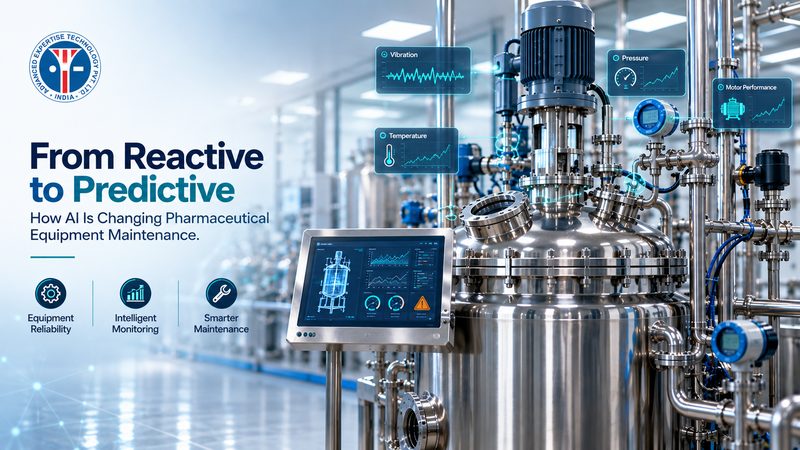
Artificial intelligence is opening new possibilities for pharmaceutical manufacturing, from process monitoring to quality analysis and equipment maintenance. Yet successful implementation depends on something fundamental: the availability of reliable equipment data and systems designed to support effective monitoring.
For pharmaceutical manufacturers, the shift toward predictive maintenance begins before an AI model is deployed. It starts with equipment design, instrumentation, automation, and the ability to understand how a machine performs over time.
Traditional maintenance strategies generally rely on scheduled servicing, operating-hour limits, or corrective action after a failure occurs. Although preventive maintenance remains essential, fixed schedules may not always reflect the actual condition of every component.
Predictive maintenance introduces a condition-based approach. By evaluating equipment data and historical operating patterns, manufacturers can identify anomalies that may warrant investigation before they develop into serious failures.
Potential benefits include better maintenance planning, improved equipment availability, reduced emergency interventions, and greater visibility into recurring operational issues.
However, these outcomes depend on implementation quality. AI cannot reliably predict every failure, particularly when data is limited, equipment behavior changes, or failure patterns are poorly understood.
The most useful monitoring parameters depend on the equipment, process, and potential failure modes.
Motor current, agitation speed, temperature, pressure, and vibration can help operators understand whether equipment is behaving as expected. Unusual trends may indicate a developing mechanical or process issue.
In suitable configurations, blower performance, airflow, temperature profiles, motor condition, and cycle duration can provide insight into equipment operation.
Drive performance, vibration, operating time, and load patterns can help maintenance teams identify deviations from normal operation.
Pressure, flow, pump condition, and filtration-cycle trends may help identify changing performance. Process variability must be considered before an unusual reading is interpreted as a mechanical fault.
These measurements are most useful when combined with equipment-specific knowledge. A change in temperature or pressure may indicate a process variation rather than an equipment failure, so context matters.
Automation provides an important foundation for connected manufacturing.
A programmable logic controller (PLC) manages defined control functions. A human-machine interface (HMI) allows operators to view equipment status, parameters, alarms, and controls. A supervisory control and data acquisition (SCADA) system can support broader monitoring, visualization, and data collection, depending on the architecture.
When appropriately configured, these technologies can make equipment behavior easier to observe and operating information easier to analyse.
However, automation and predictive maintenance are not the same thing. A PLC-based machine does not automatically use AI, and a monitoring dashboard does not necessarily predict future failures. Predictive capability requires suitable data, analytical methods, and a process for evaluating and acting on findings.
This distinction is important when manufacturers specify new equipment or plan upgrades.
Pharmaceutical equipment operates within a quality system where changes must be assessed carefully.
Adding sensors, connecting new software, changing control logic, or introducing analytical models may affect existing systems and procedures. Manufacturers must evaluate the impact on validated processes, data integrity, access controls, records, and established maintenance practices.
A responsible implementation should address:
AI should support qualified personnel rather than independently making unreviewed decisions that could affect product quality or equipment safety.
Manufacturers do not need to introduce advanced AI into every machine immediately. A more practical approach is to evaluate equipment requirements with future monitoring in mind.
During equipment selection, consider whether the design supports relevant instrumentation, accessible maintenance points, suitable control interfaces, reliable operating records, safety interlocks, and integration with plant-level monitoring systems.
Documentation also matters. Equipment specifications, operating procedures, and qualification documents can help establish a clear baseline for operation and maintenance.
ADVETPL’s portfolio includes pharmaceutical and process equipment with applicable options such as PLC-based controls, touch-screen HMI, SCADA packages, safety interlocks, and qualification documentation. These capabilities can be relevant when manufacturers are planning equipment that fits into more connected production environments. The exact configuration depends on the selected machine and project requirements.
A structured implementation can begin with three steps.
This approach allows manufacturers to build capability gradually while maintaining engineering oversight and appropriate quality controls.
The future of pharmaceutical manufacturing will involve more connected systems, better operational visibility, and increasingly data-informed maintenance decisions. But smart manufacturing does not begin with AI alone.
It begins with equipment that is appropriately designed, instrumented, controlled, documented, and maintained.
For pharmaceutical manufacturers evaluating new process equipment, ADVETPL’s equipment engineering and applicable automation capabilities offer a foundation to consider these requirements during project planning.
The most valuable equipment is not merely capable of performing a process. It is equipment whose performance can be understood, monitored, and maintained throughout its working life.